
Quiet Korea · Gurye, Jirisan · Temples & Mountains
Snow at Gucheungam
A small hermitage above Hwaeomsa, held up by quince trees, where I watched the snow fall with a dog for company.
Hwaeomsa is one of the great temples of Jirisan. Its halls are vast, its eaves heavy with color, and on most days its courtyards are full: tour buses, school groups, families posing in front of the main hall. It is worth seeing. But if what you are looking for is stillness, keep walking.
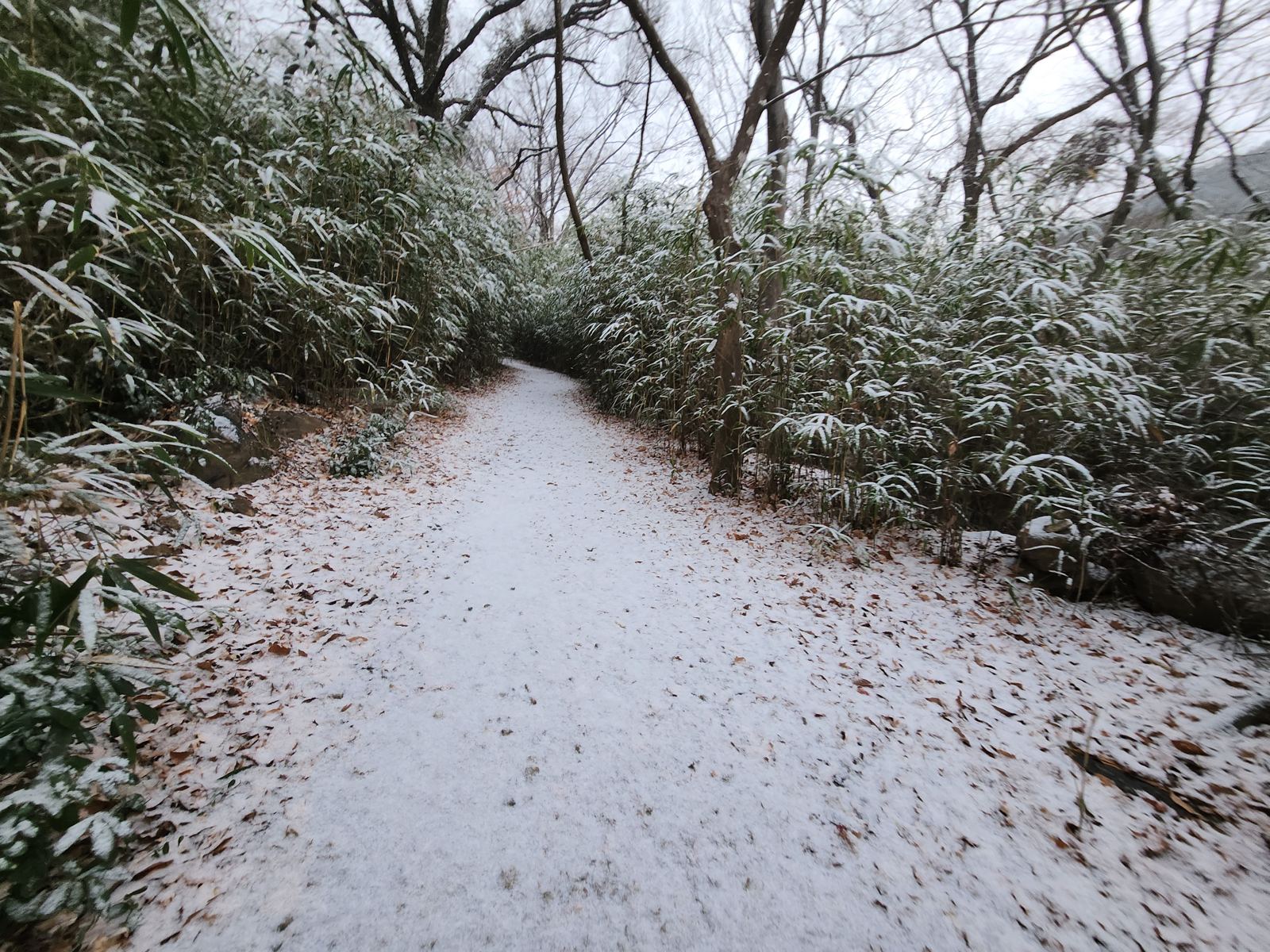
Behind the main temple, a narrow path climbs into the woods. It is only about 300 meters, five or ten minutes at an easy pace, and it leads to a small hermitage called Gucheungam (구층암).
I went on a morning when it was snowing. The bamboo on either side of the path bent under a thin white layer, and the fallen oak leaves showed through the snow like a pattern on paper. By the time the trees opened up and the hermitage appeared, the noise of the main temple was gone.
Pillars that are still trees
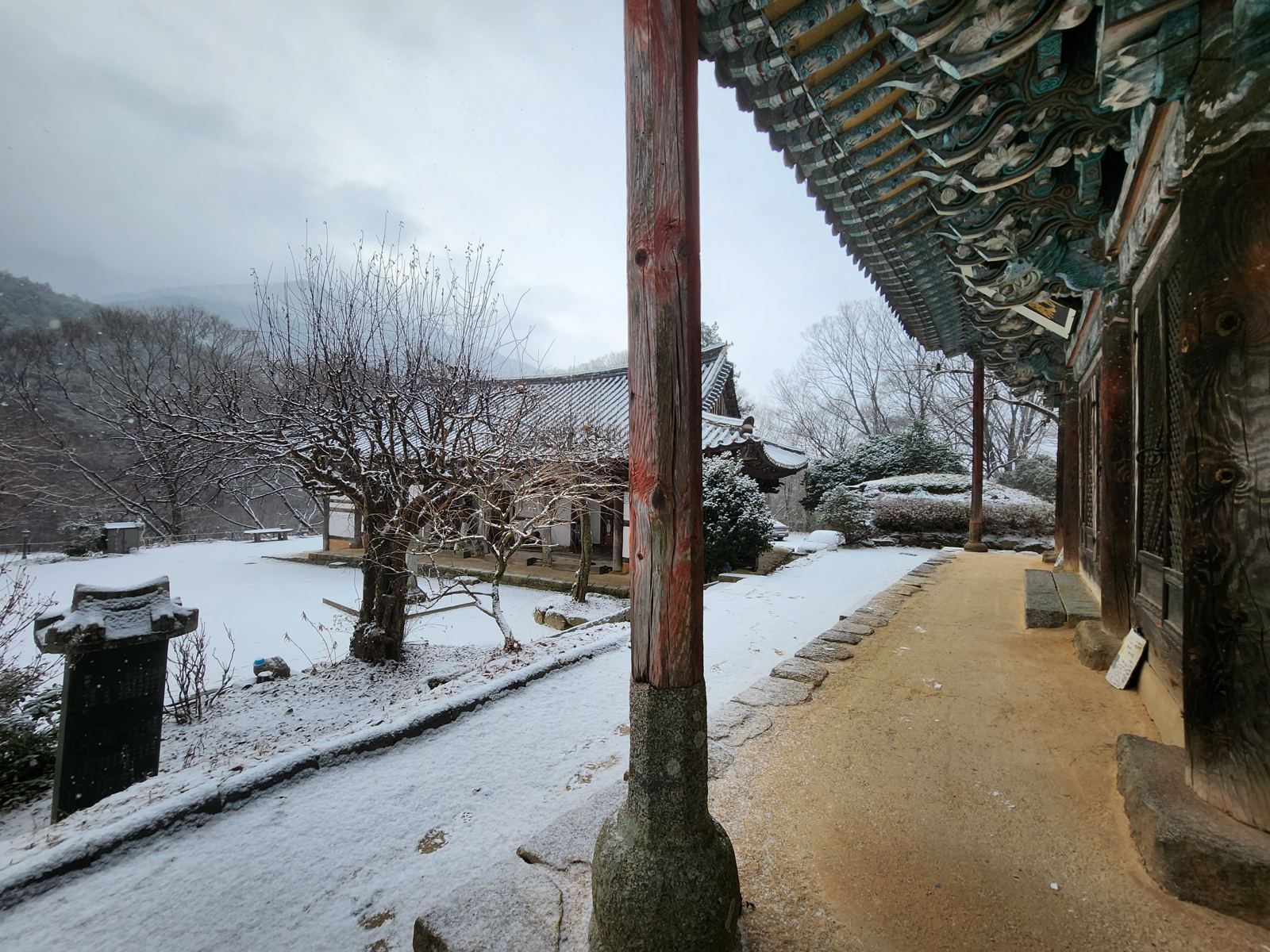
Gucheungam is modest: a few low buildings around a small courtyard, a weathered stone pagoda, a lantern. What makes it unlike any other temple I have visited is the wood.
Several of the pillars holding up the eaves are quince trees, used almost exactly as they grew. No one squared them off or planed them smooth. The trunks twist, split and swell; knots and broken branch stubs still jut out where the tree once reached sideways. At the base of one pillar, the old wood spreads across the foundation stone as if the tree had simply decided to stay.
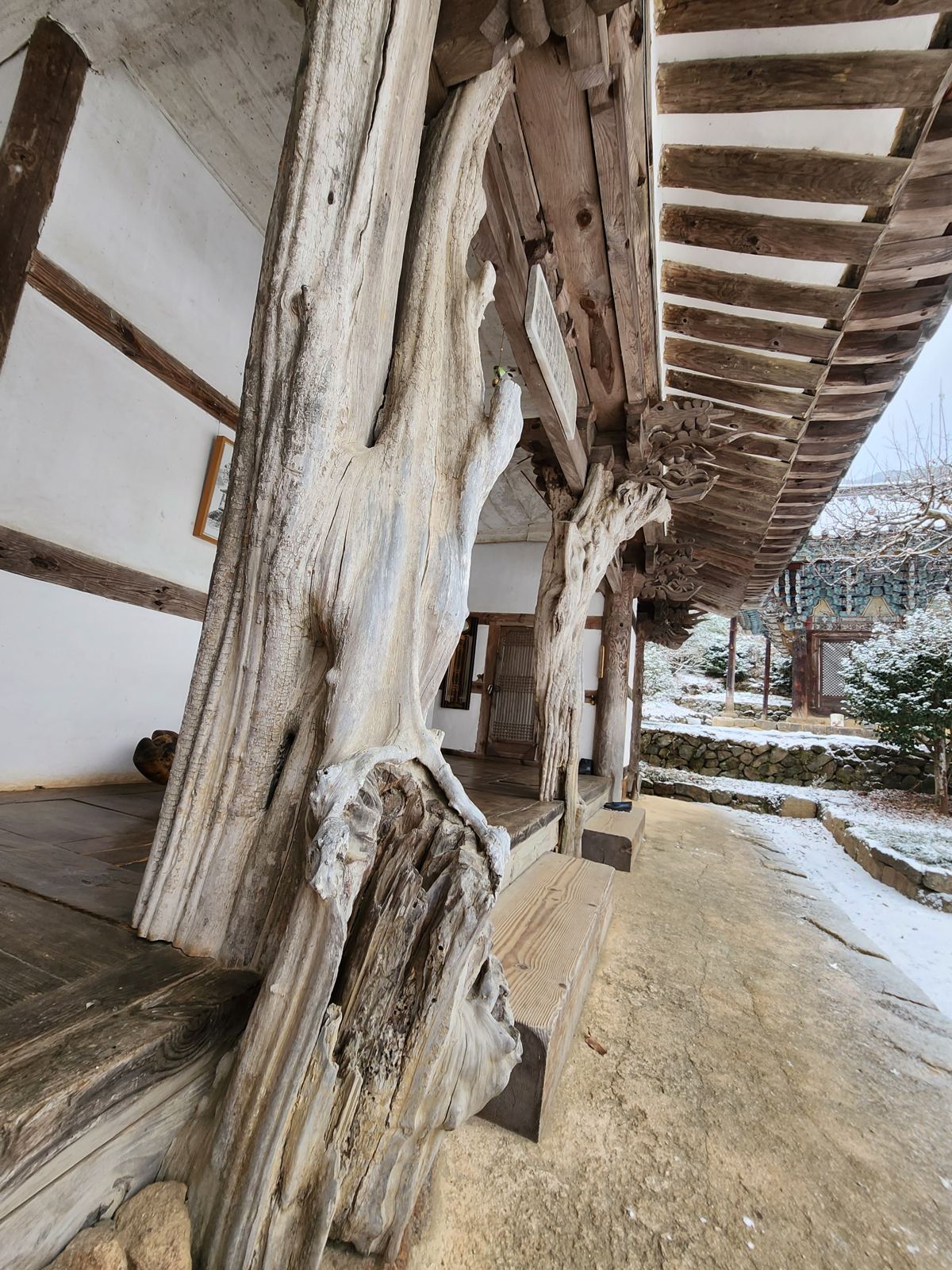
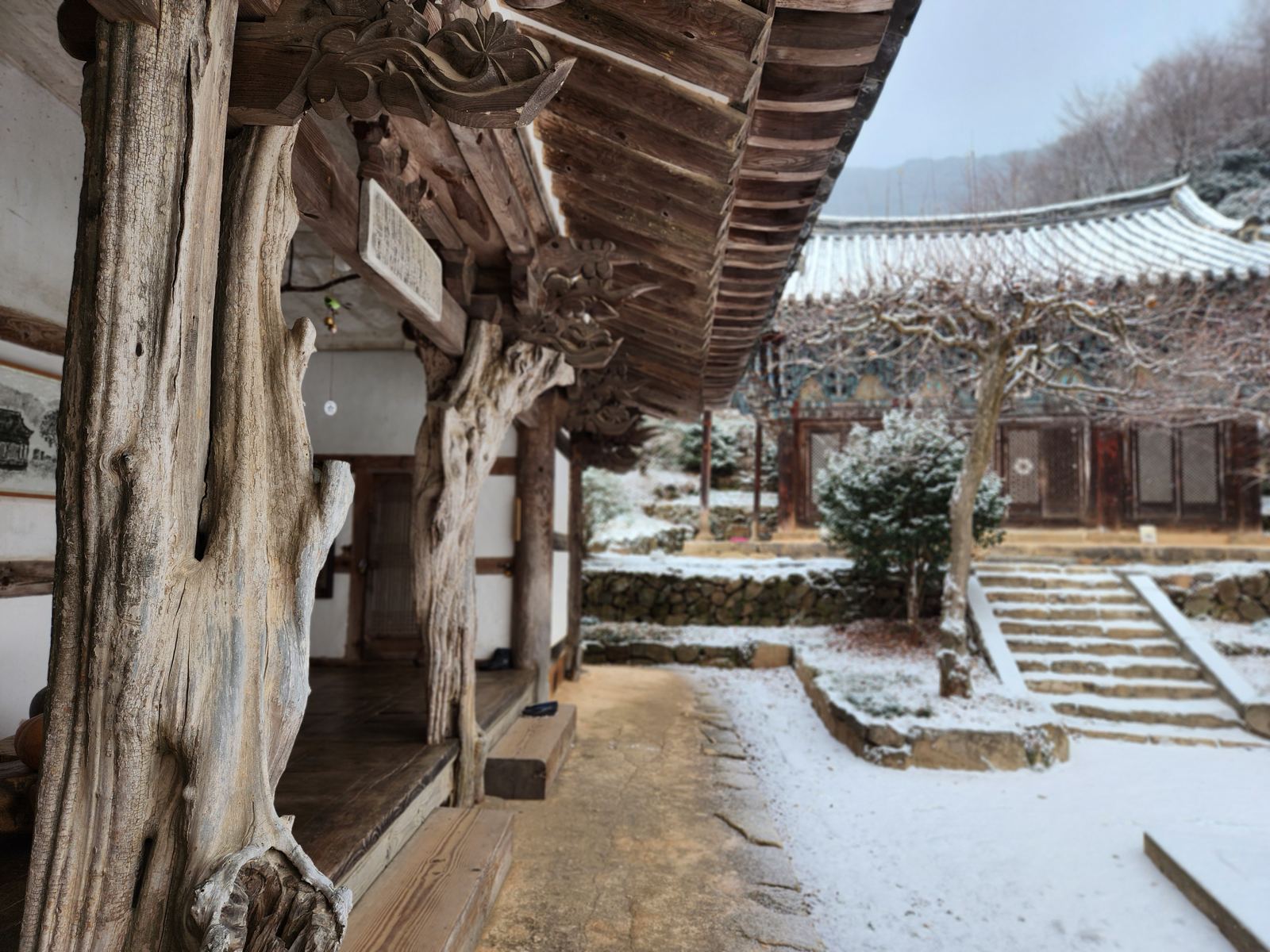
The story usually told is that the quarters were rebuilt at the end of the nineteenth century, and the builders used quince trees that had grown in the yard, by some accounts around two hundred years old. Most traditional Korean architecture prizes straight, disciplined timber. Here someone chose the opposite, and let the building accept the tree rather than the other way around. Standing under those eaves, you get the strange feeling that the hermitage is not quite finished growing.
A companion in the snow
I was not alone for long. A small white-and-brown dog that lives at the hermitage came trotting over, tail wagging, to say hello. It circled my feet for a while, looking over the stranger. Then it went to the wooden step below the veranda, beside two pumpkins drying on a stump table, and sat down quietly. It wanted nothing more from me. It simply sat, watching the snow come down, and so did I.
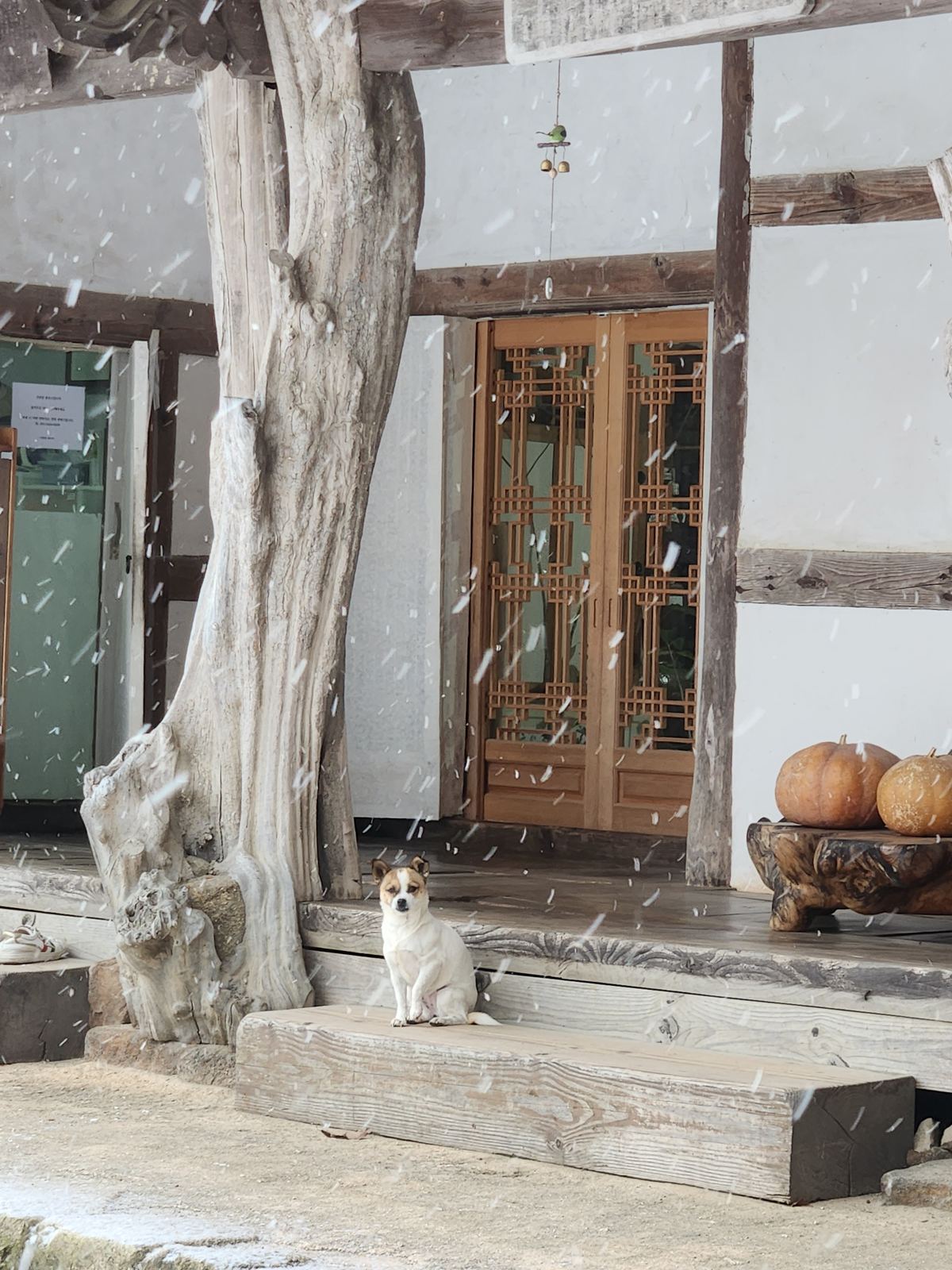
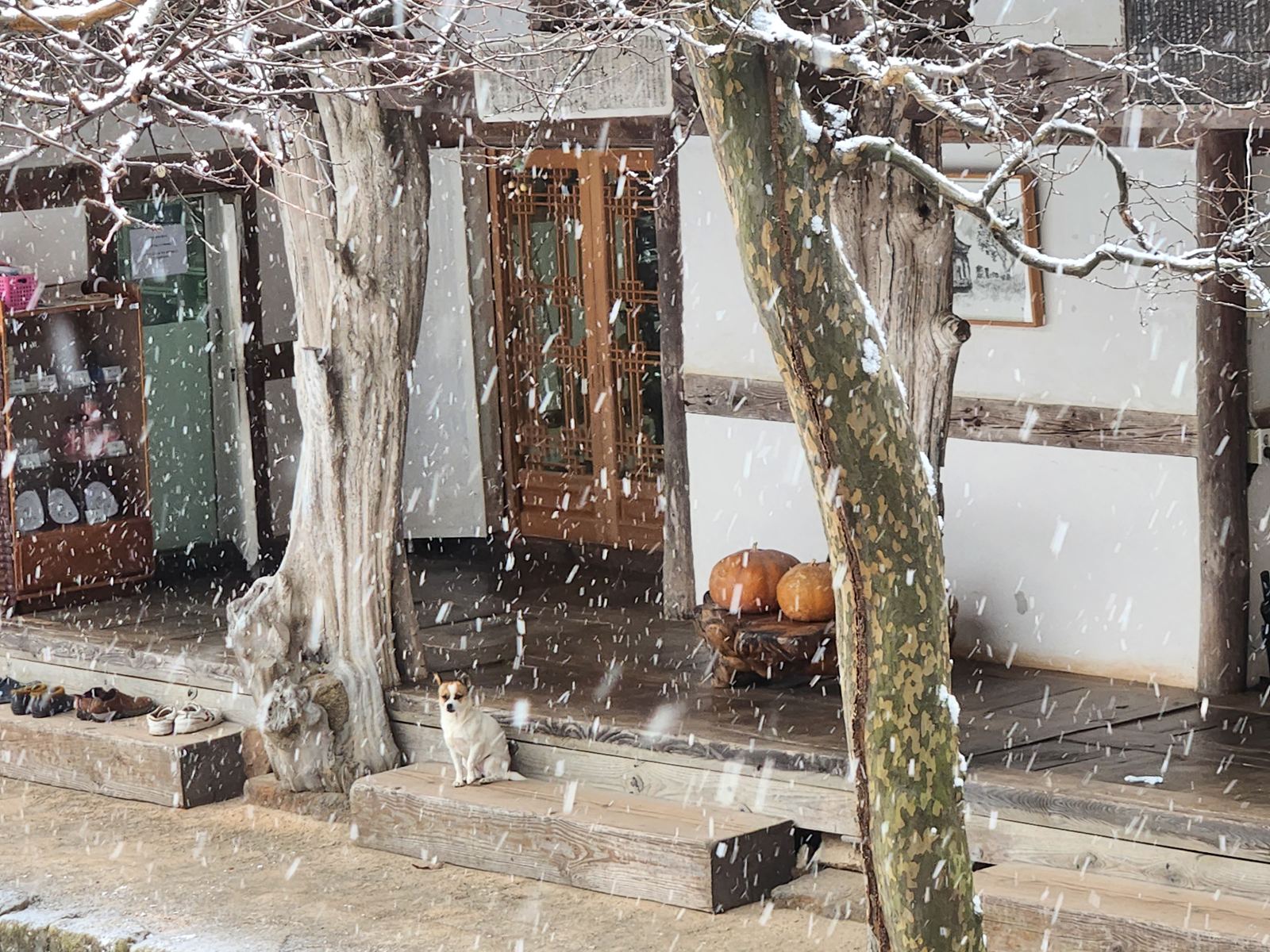
We stayed like that for a long time. Snow fell into the courtyard, onto the roof tiles and onto the shoulders of the stone pagoda. Every so often the dog looked over at me, then back at the snow. A small bell hung from the eaves, but there was no wind to ring it.
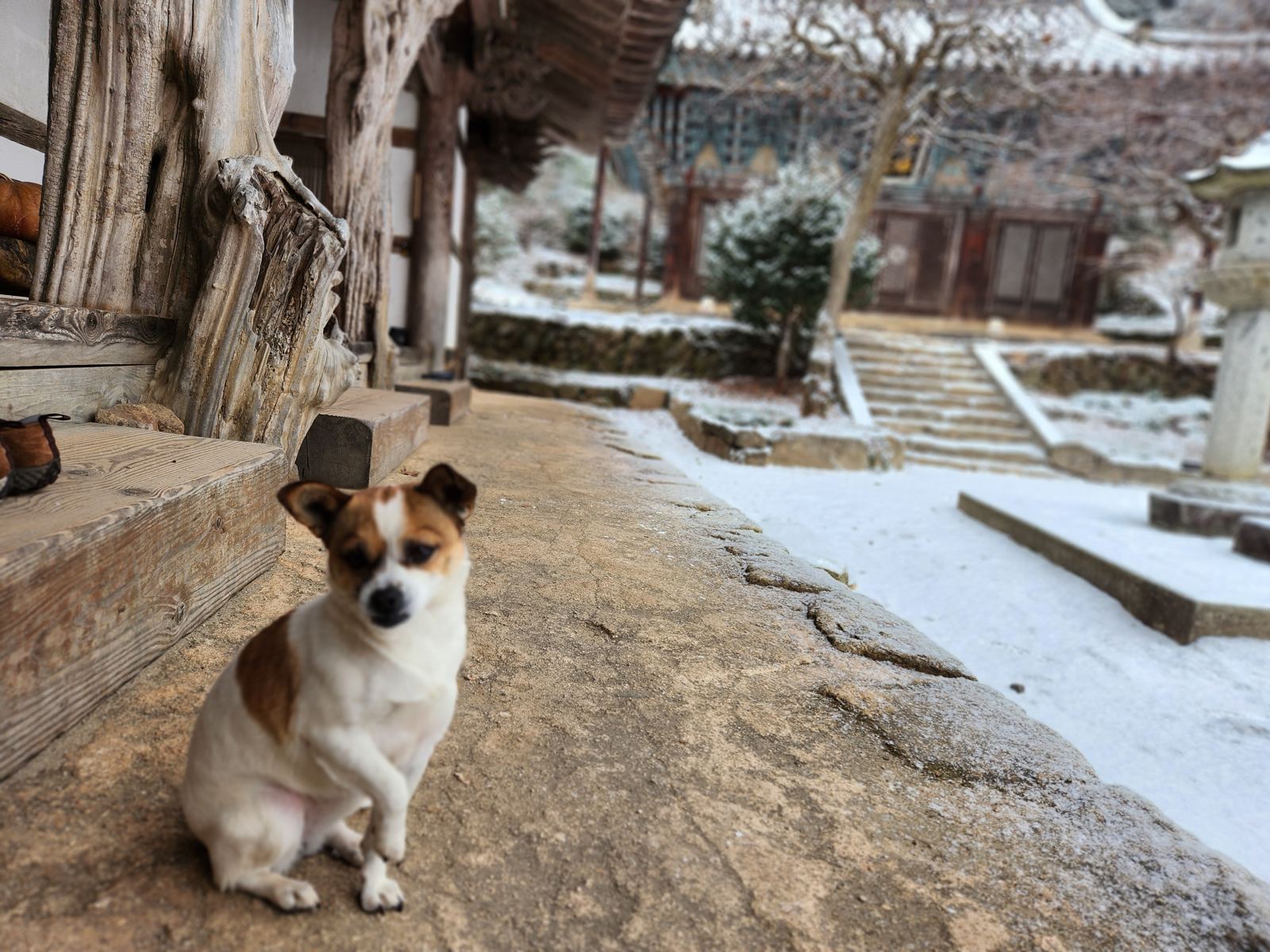
I have spent a good deal of time in Korean temples, and I can't remember a quieter hour in any of them.
Looking out
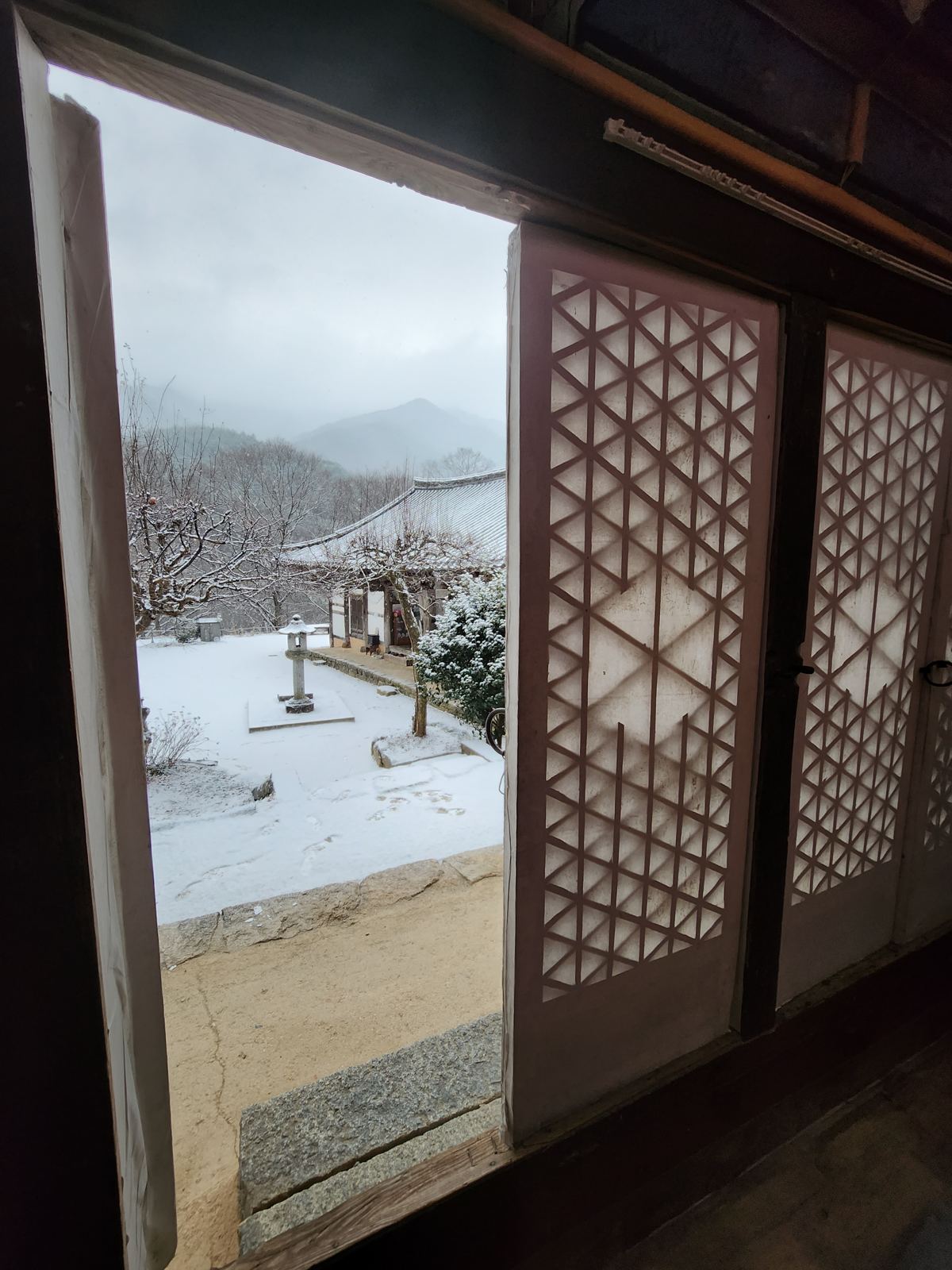
From inside one of the rooms, a lattice door frames the view: the snowy courtyard, a stone lantern, the curved roof of the next hall, and behind it the grey, cloud-softened ridges of Jirisan.
A name and a pot of tea
Gucheungam means “Nine-Story Hermitage,” which is a little puzzling when you stand in the yard. The stone pagoda in front of the main building has only three tiers. It is not a polished monument. It was pieced back together from fragments that had once lain scattered, and the joins still show. A small seated Buddha is carved into its body, worn soft by the weather.
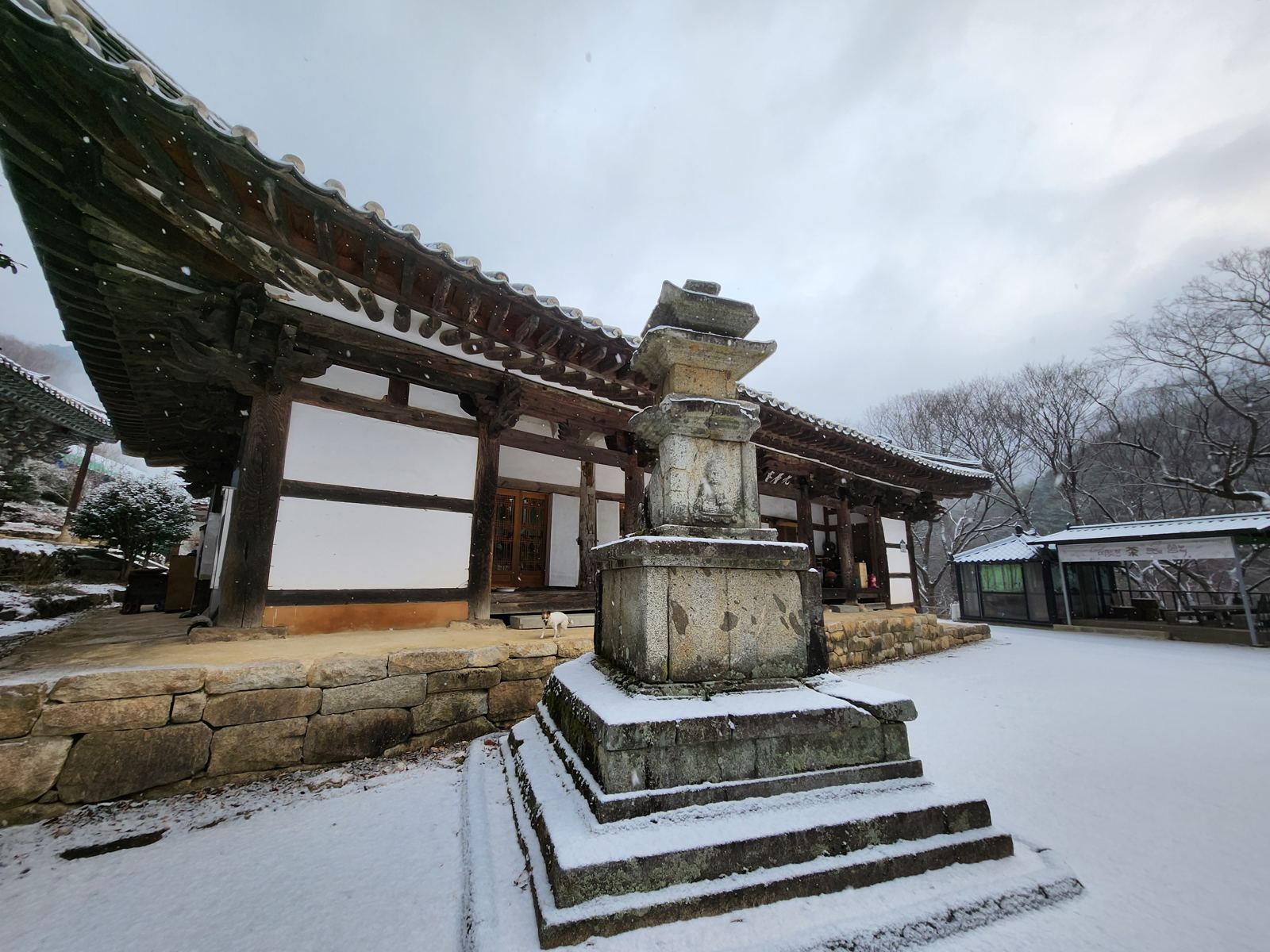
On the right edge of the yard there is a small glass-walled tea room with a 茶 (tea) sign. Gucheungam is known for its tea. The hills around Hwaeomsa are one of the places said to be where tea was first planted in Korea, and wild tea still grows among the bamboo. The hermitage's monk, Venerable Deokje, has gathered and processed this wild tea by hand for more than twenty years. In 2026 he also opened a small tea room at the Gurye five-day market, so you can taste the hermitage's tea in town as well.
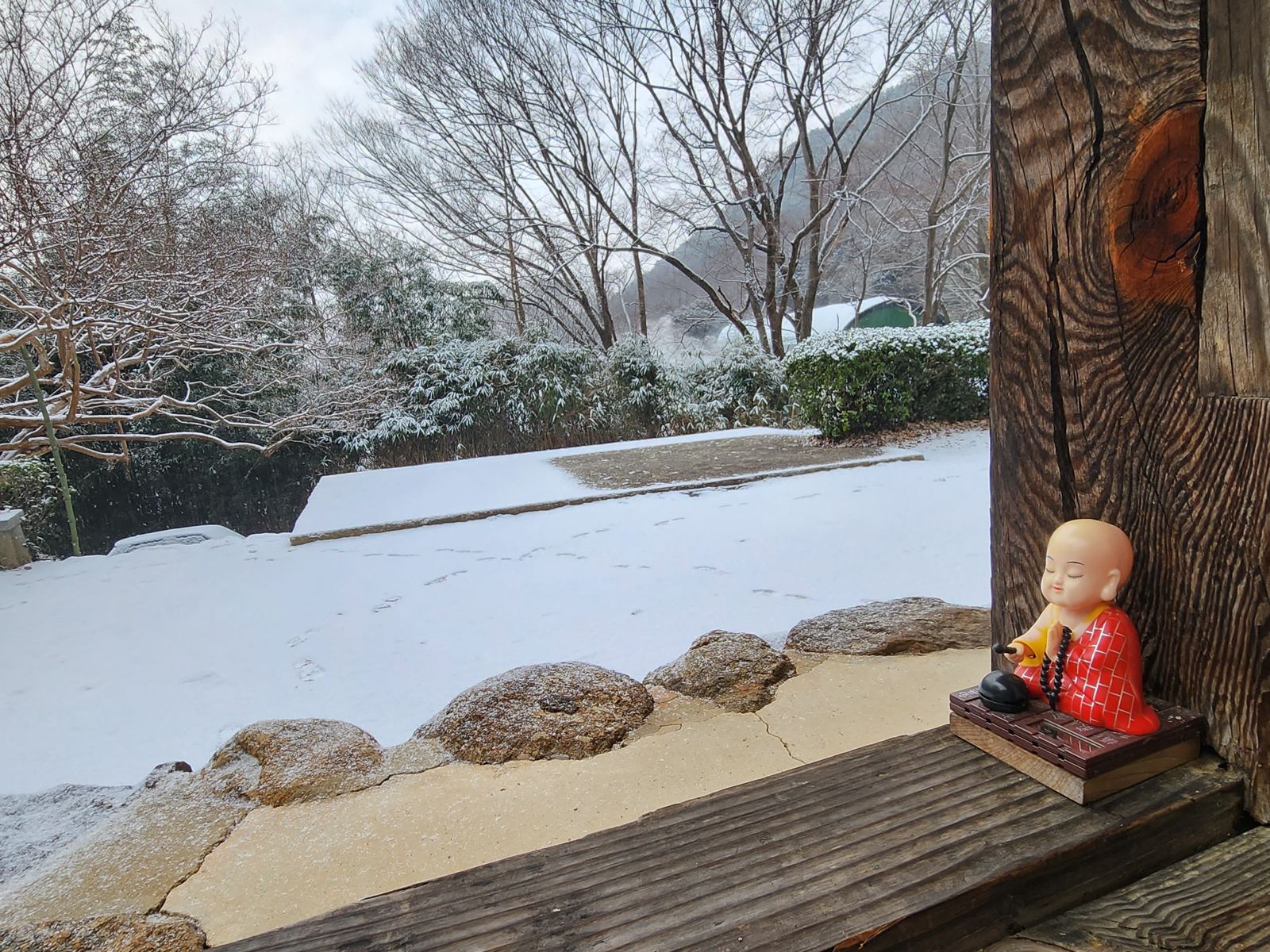
On the edge of the terrace, someone had placed a tiny figurine of a young monk, eyes closed, beating a wooden moktak. It is a small, almost playful touch, and it suits the place.
Why go
Hwaeomsa is magnificent, and you should see it. But it is also busy, and its grandeur asks something of you: attention, admiration, a place in the line.
Gucheungam asks nothing. It is small, slightly crooked and very still. If you want a moment of real peace in the middle of a temple visit, take the extra ten minutes and walk up the bamboo path. Go on a weekday if you can. Go in the snow if you're lucky.
And if the dog is there, sit with it for a while.
Visiting
- Where
- Behind Hwaeomsa Temple, Gurye County, South Jeolla Province, on the southwestern side of Jirisan.
- Getting there
- From the Hwaeomsa grounds, follow the signposted path uphill behind the main hall for about 300 meters (5–10 minutes).
- Best time
- Early morning or a weekday. I arrived a little before 9 a.m. and had the place almost to myself.
- Footing
- The path is short and gentle, but slippery in snow. Wear shoes with good grip.
- Etiquette
- This is a working hermitage where monks live. Keep your voice low and don’t enter rooms or the tea room uninvited.
- Tea in town
- Gucheungam's tea room at the Gurye five-day market. Opening is tied to market days and calls for a reservation, so check before you go.