
Quiet Korea · Okcheon, Sikjangsan · Temples & Mountains
Dawn at Gujeolsa
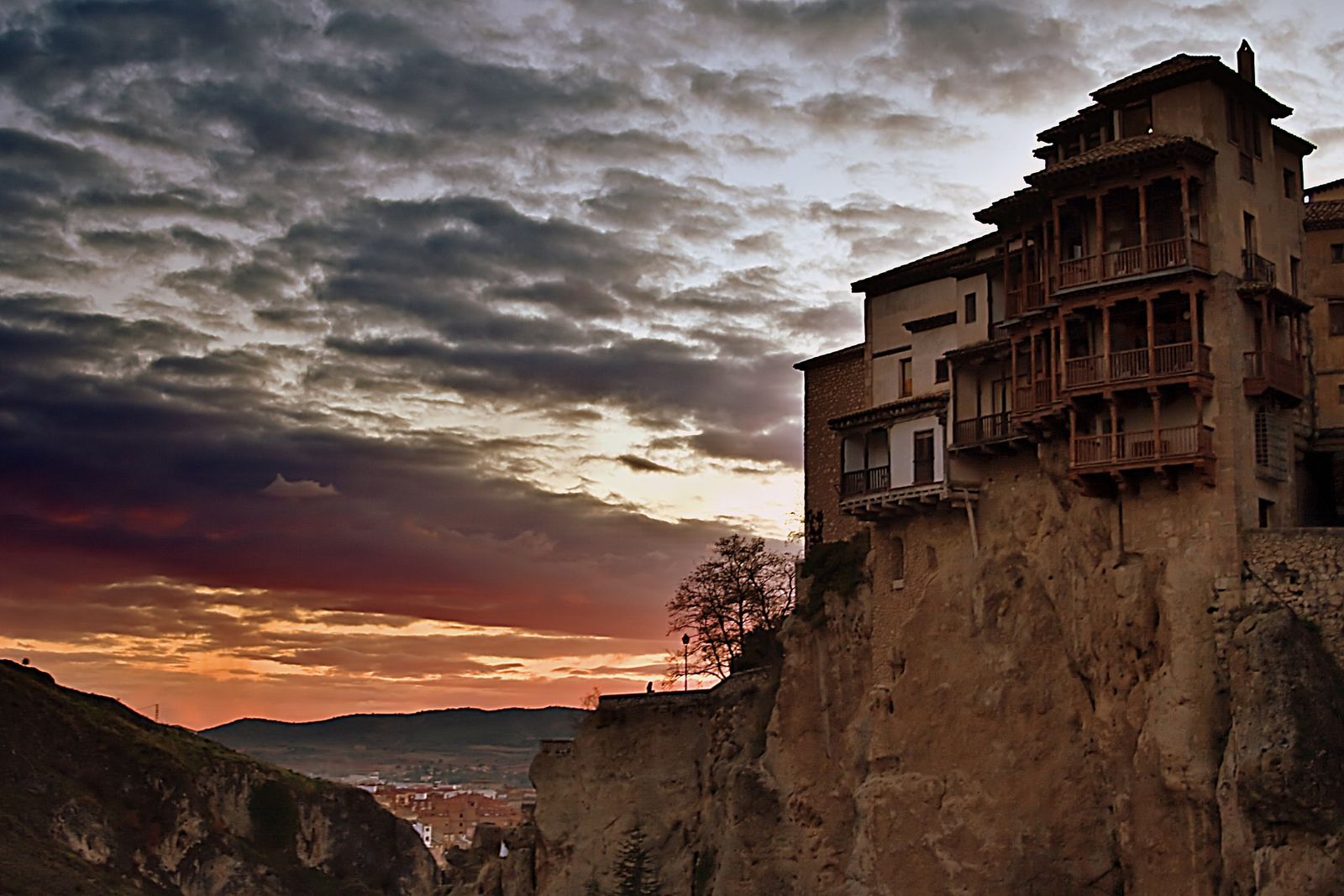
A small mountain temple on the edge of Daejeon, with two tiny shrines clinging to a cliff face like Cuenca's hanging houses.
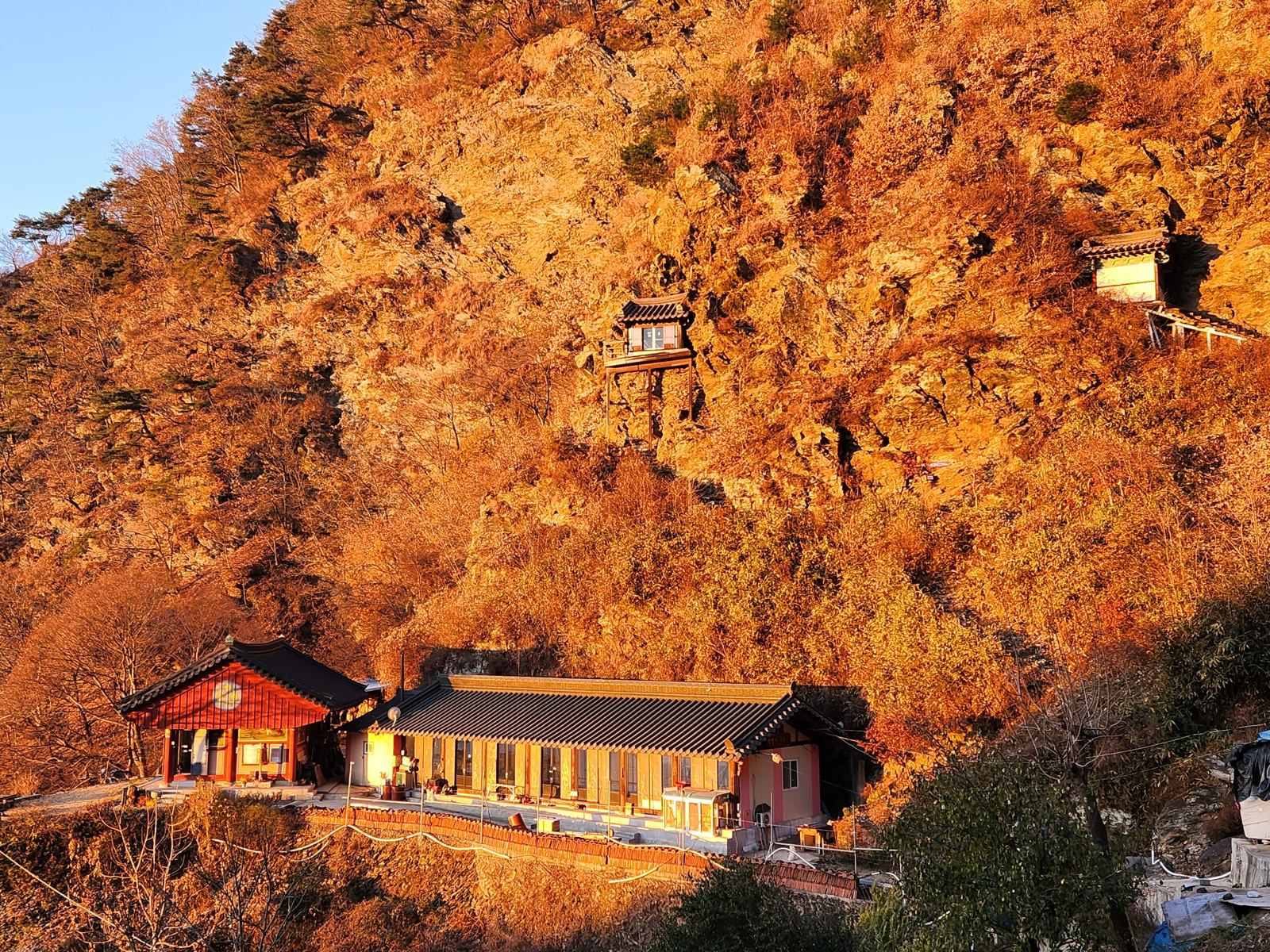
Daejeon is one of Korea's larger cities, home to nearly a million and a half people. On its eastern edge rises Sikjangsan, and just over the ridge, on the Okcheon side, is a temple that feels much farther from the city than it is. Gujeolsa (구절사) is small and a little rough around the edges, and it has one feature I have not seen at any other Korean temple.
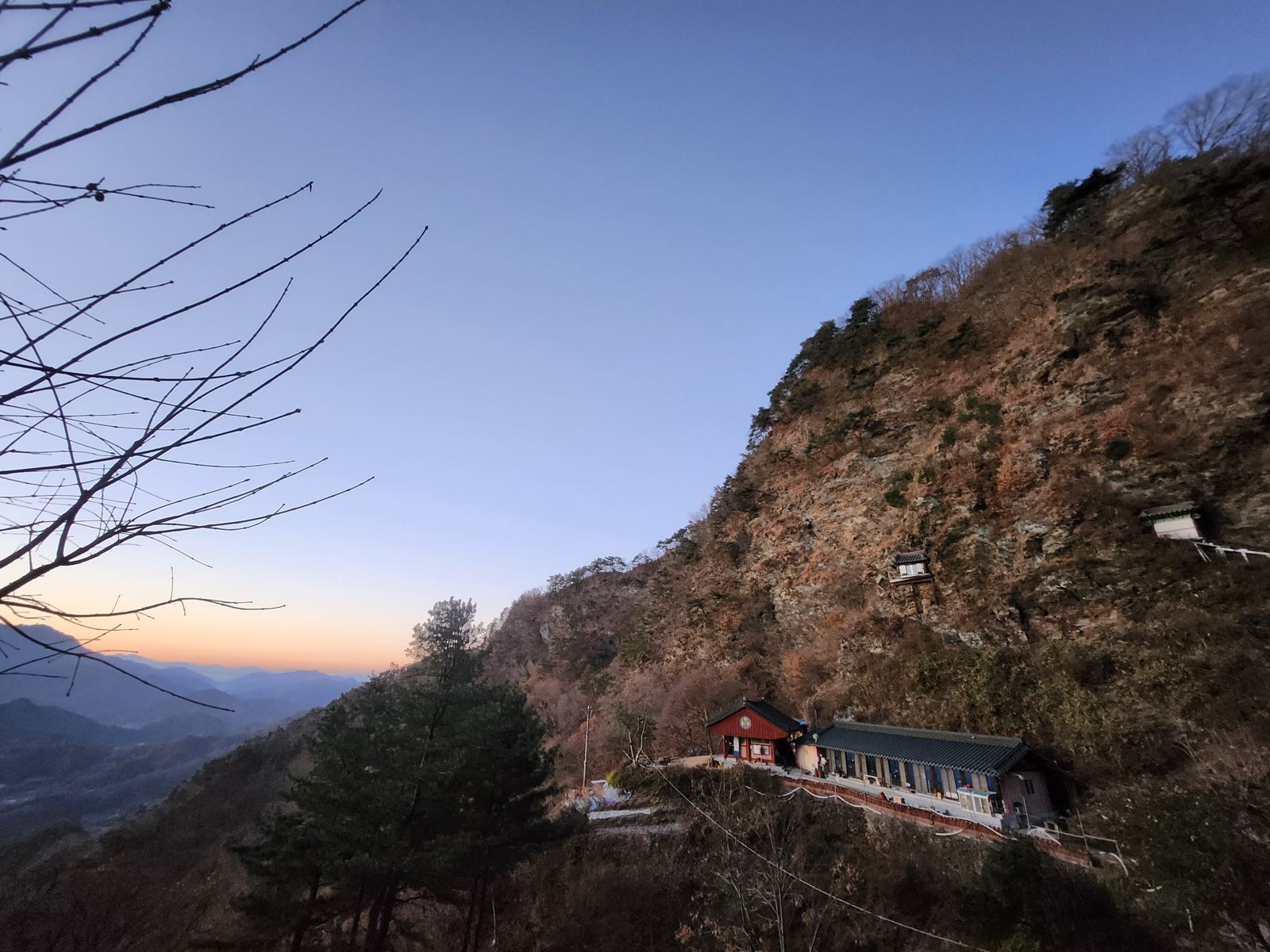
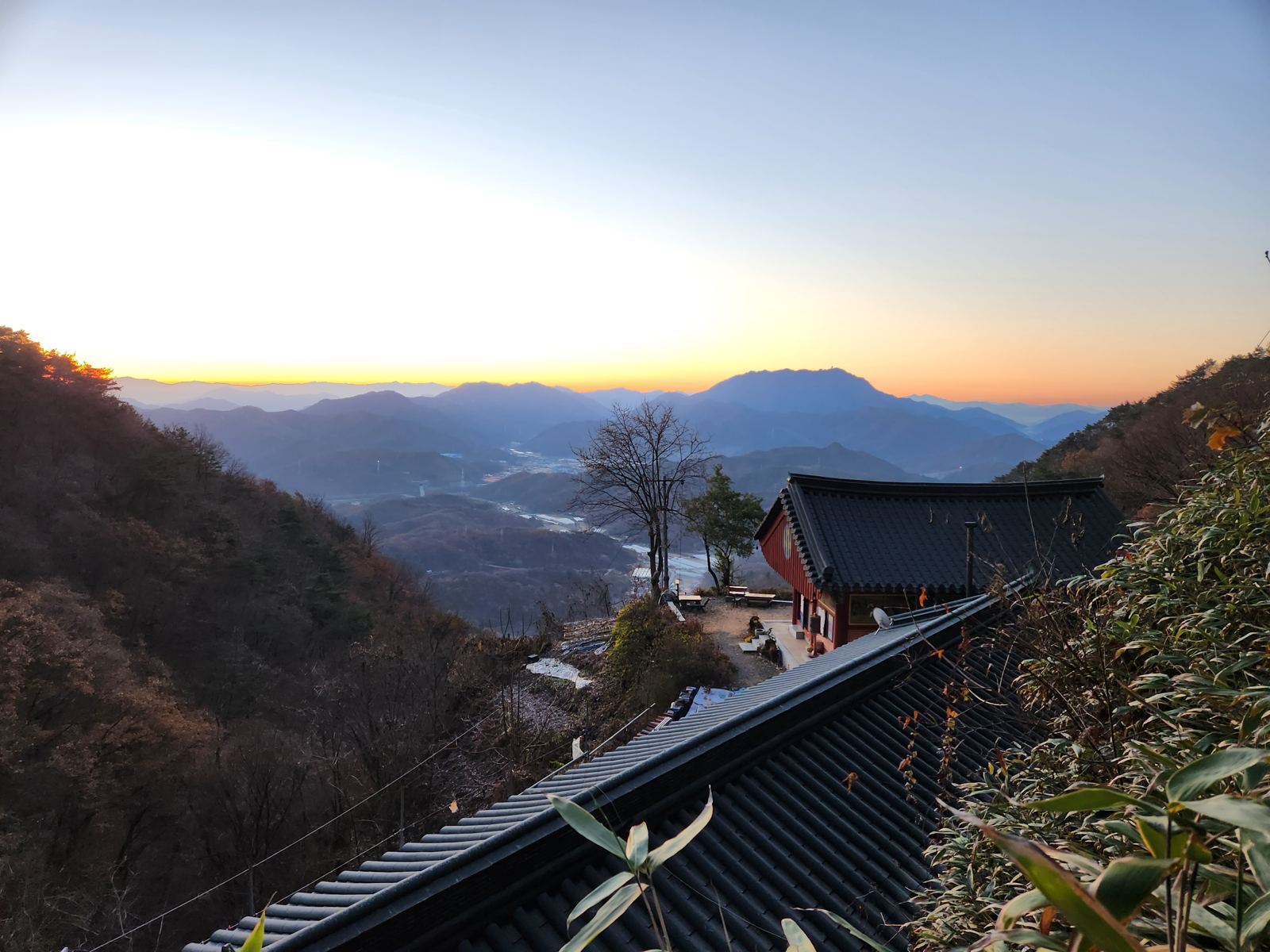
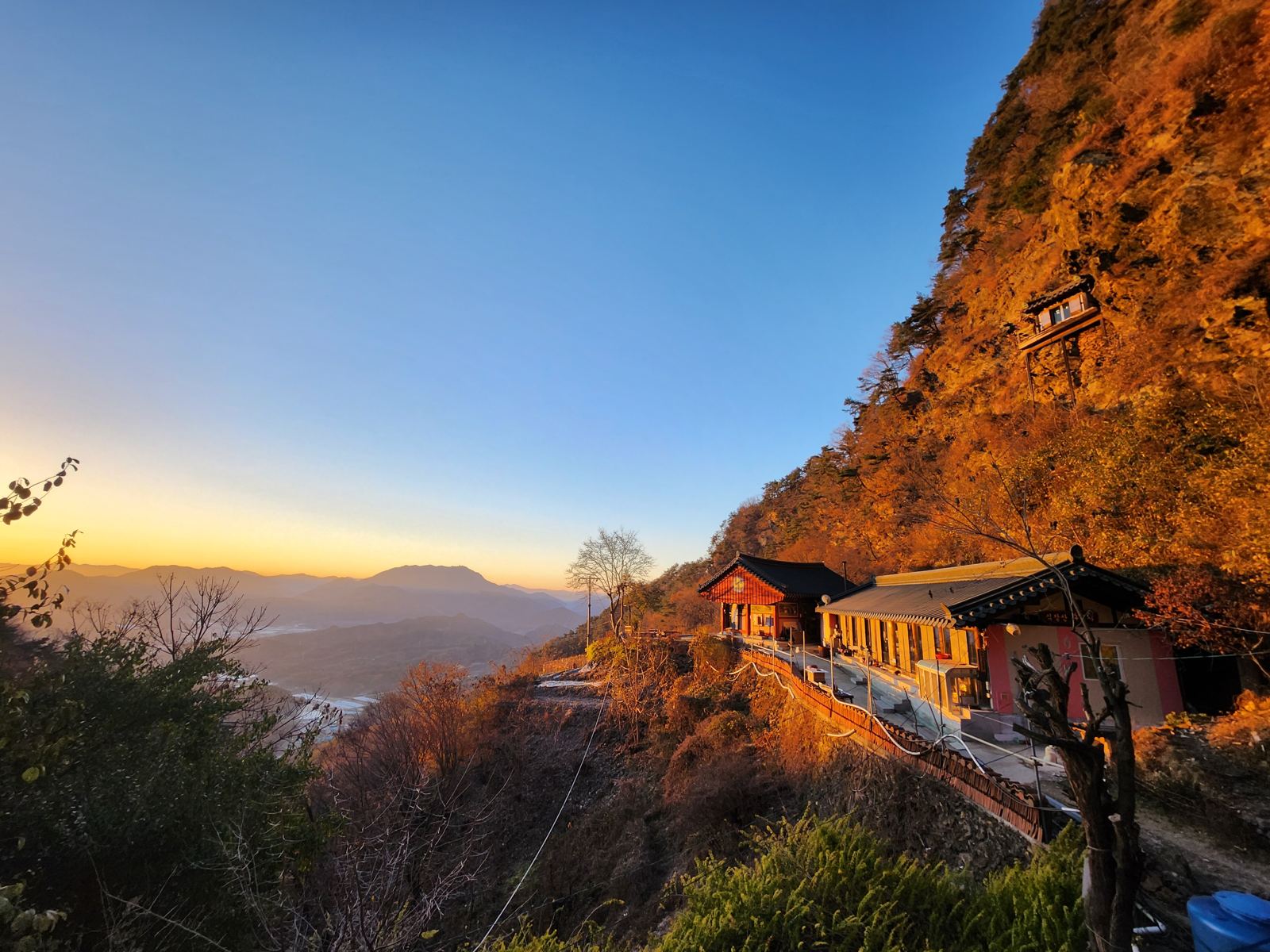
I arrived a little after seven on a late-November morning. The road to the temple winds up through the forest; in May, I am told, it is lined with acacia blossoms. When I got there, the sky over the valley was turning from blue to orange, and the cliff behind the temple was still in shadow.
Houses that hang from the rock
At the foot of the slope sit the main hall and a long, low residence. Look up, though, and you see two tiny buildings fixed to the cliff, one held out over the drop on thin wooden posts, the other tucked into a hollow in the rock. These are the Sansingak, the shrine to the mountain spirit, and the Chilseonggak, the shrine to the Seven Stars of the Big Dipper. Almost every Korean temple has these two shrines, usually as modest buildings at the back of the grounds. At Gujeolsa they were built in 1979 straight onto the mountainside.
They are very small, hardly bigger than a garden shed. But the first time I saw them, my mind went to Cuenca in Spain, where the Casas Colgadas, the “hanging houses,” lean their wooden balconies out over the Huécar gorge. The scale is completely different, and nobody built these shrines to impress anyone. Still, the idea is the same. Rather than wait for flat ground, someone decided the building should go where the rock is.
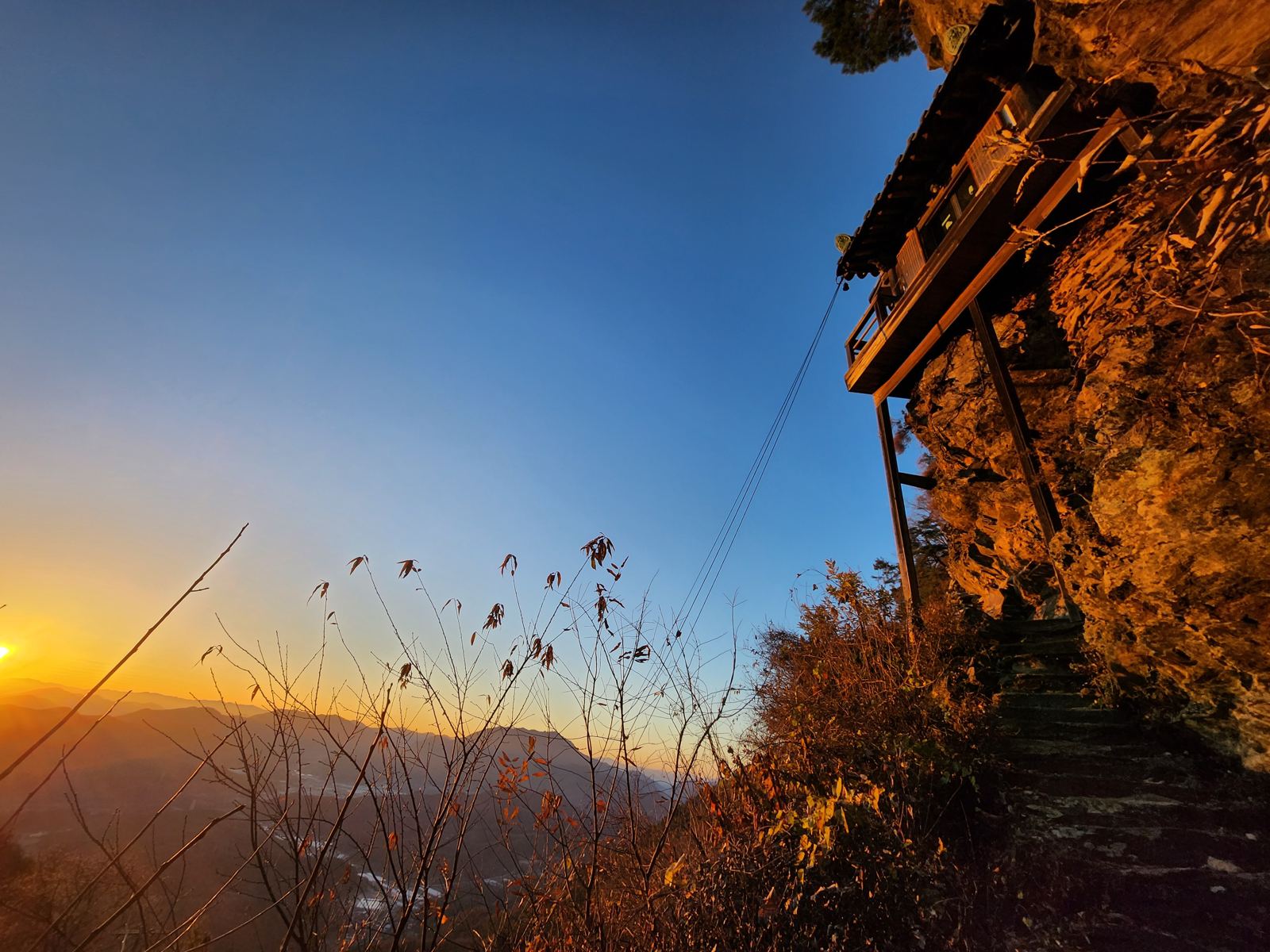
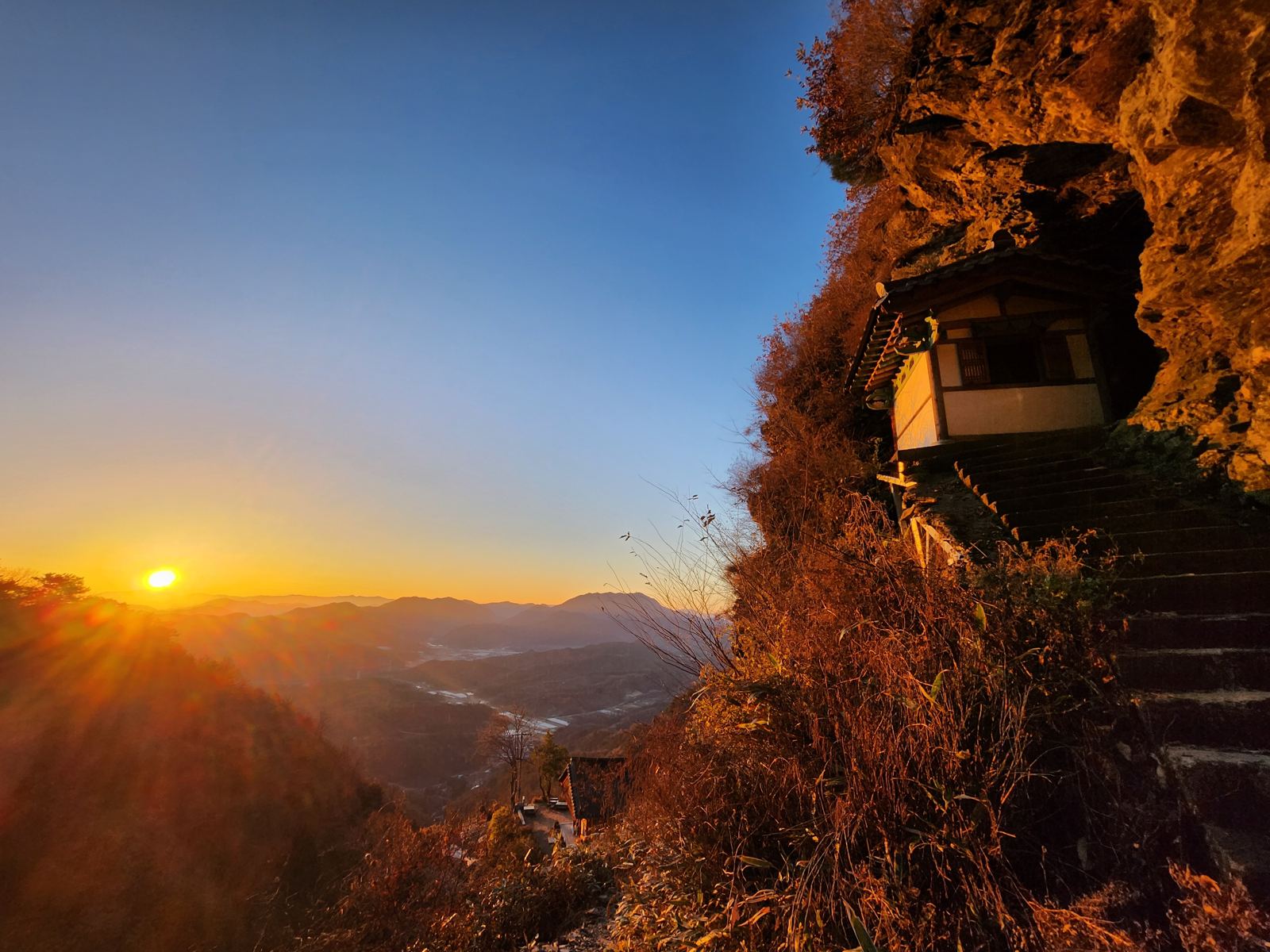
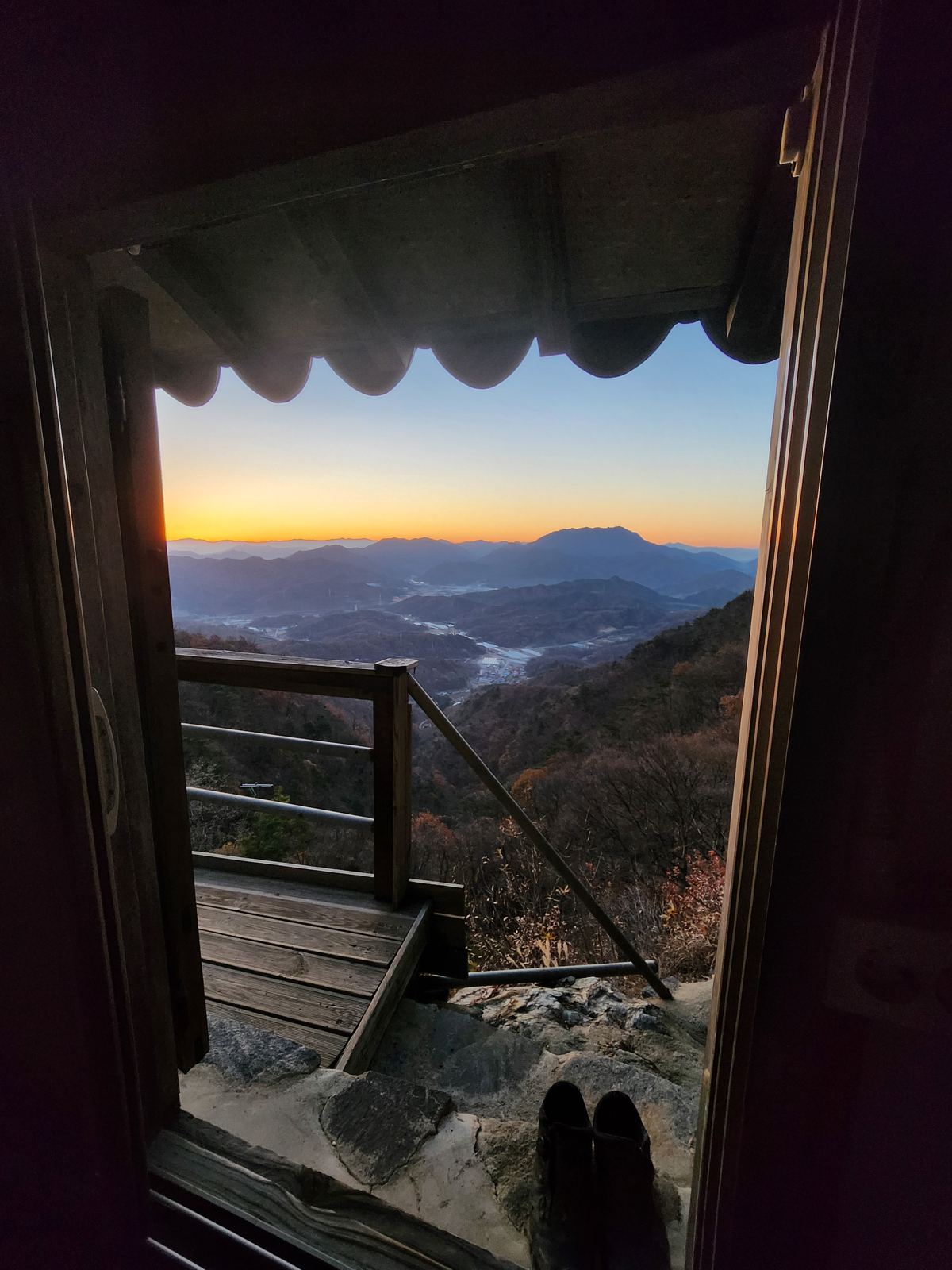
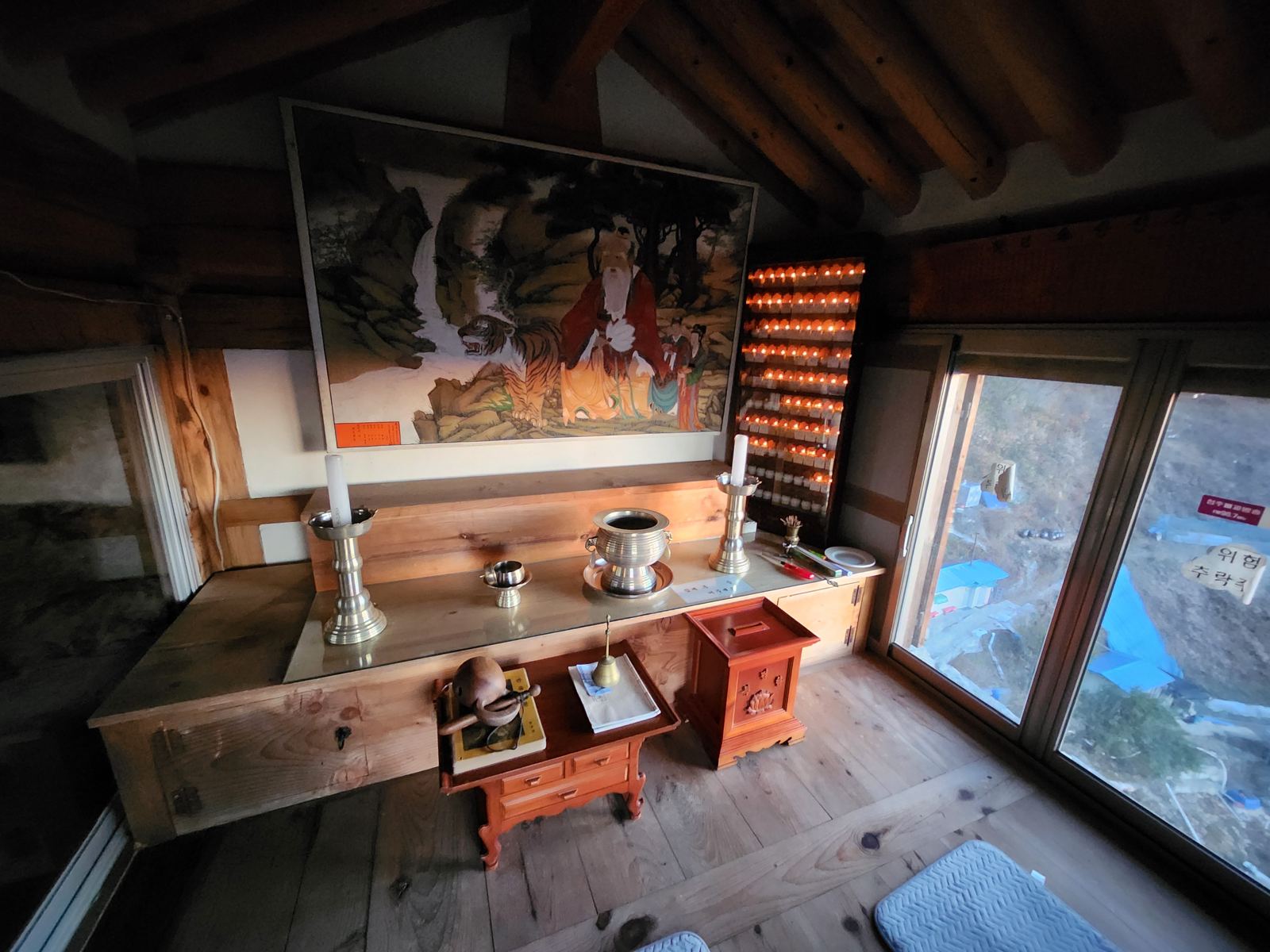
A steep flight of stone steps leads up to them. Inside the higher one there is room for perhaps three people to bow. A painting of the mountain spirit, an old man with a white beard sitting beside his tiger, hangs above a simple altar, with rows of small prayer lamps glowing to one side. Through the window you look straight down the cliff. A hand-lettered sign on the glass reads 위험 추락주의: “Danger, risk of falling.”
Waiting for the sun
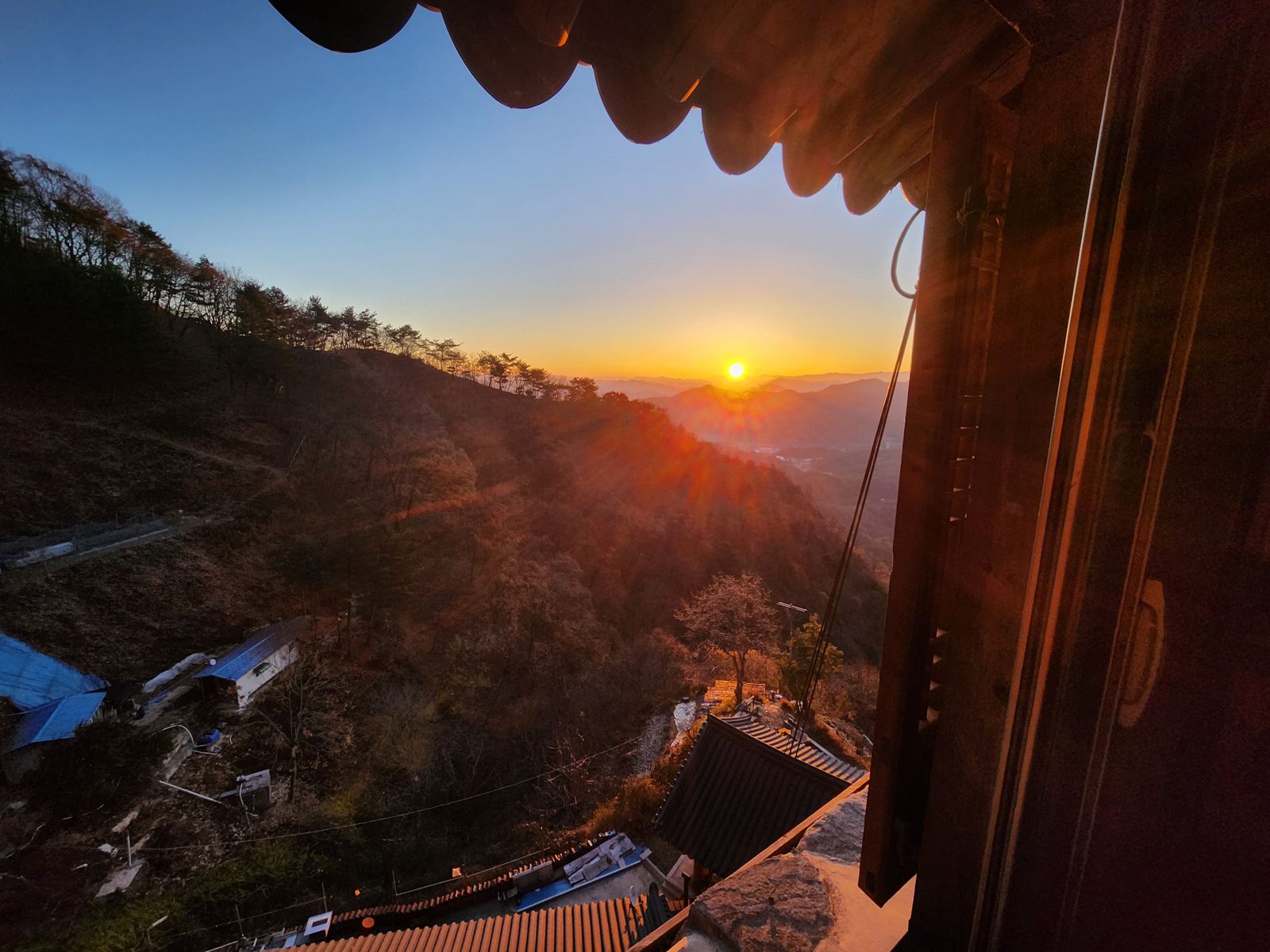
I stood on the little balcony and waited. Below, the valley was still blue with morning haze, and ridge after ridge faded toward the horizon. At about twenty past seven the sun came up over the far mountains, and the light ran down the cliff in a few minutes, turning the rock and the dry autumn grass a deep orange.
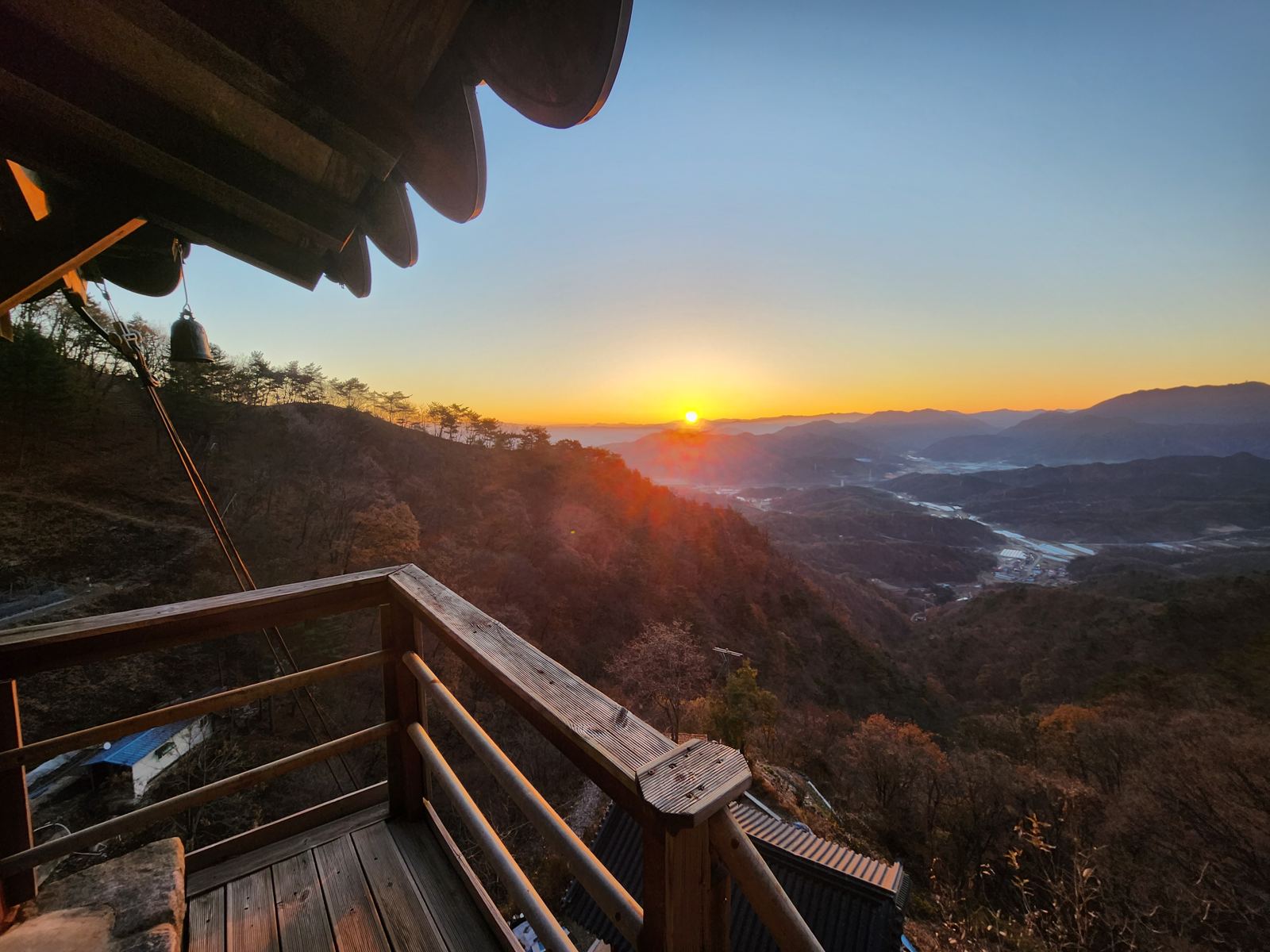
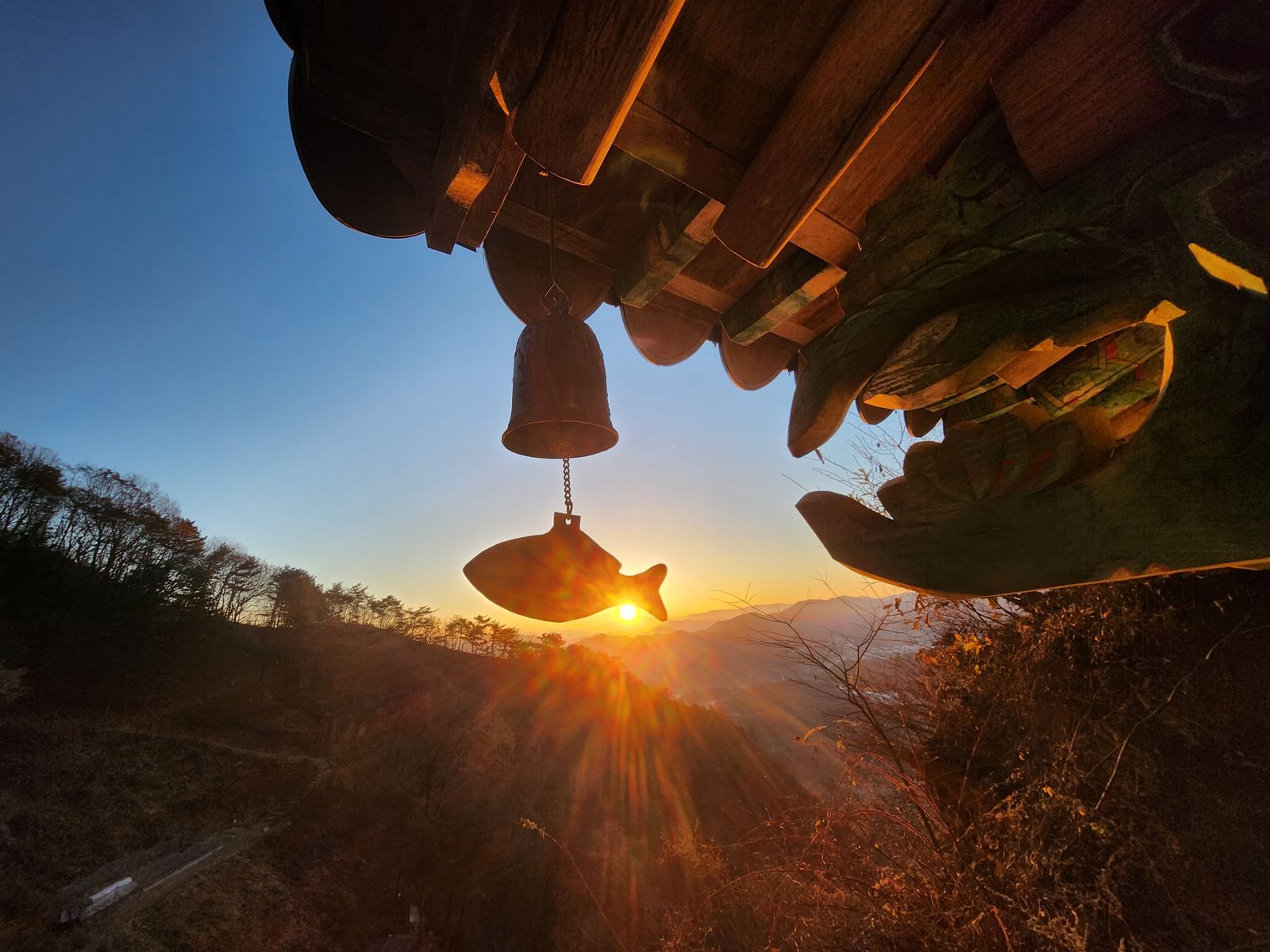
A bronze wind bell hangs from the corner of the eaves, and its clapper is shaped like a fish, as on many Korean temple bells. A fish never closes its eyes, so it stands for a mind that stays awake. With the sun right behind it, the little fish seemed to be swimming through the light.
Small residents of the rock
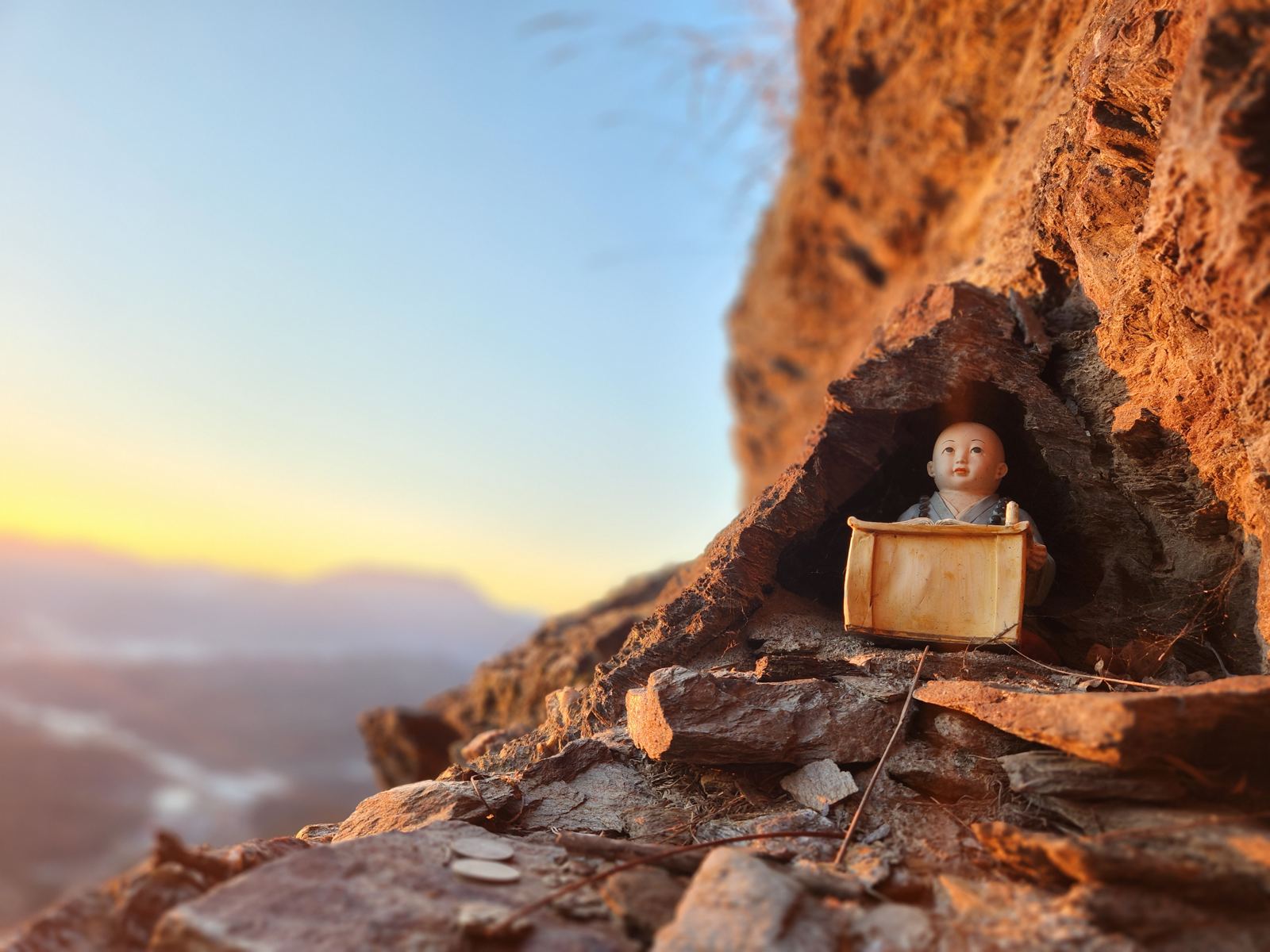
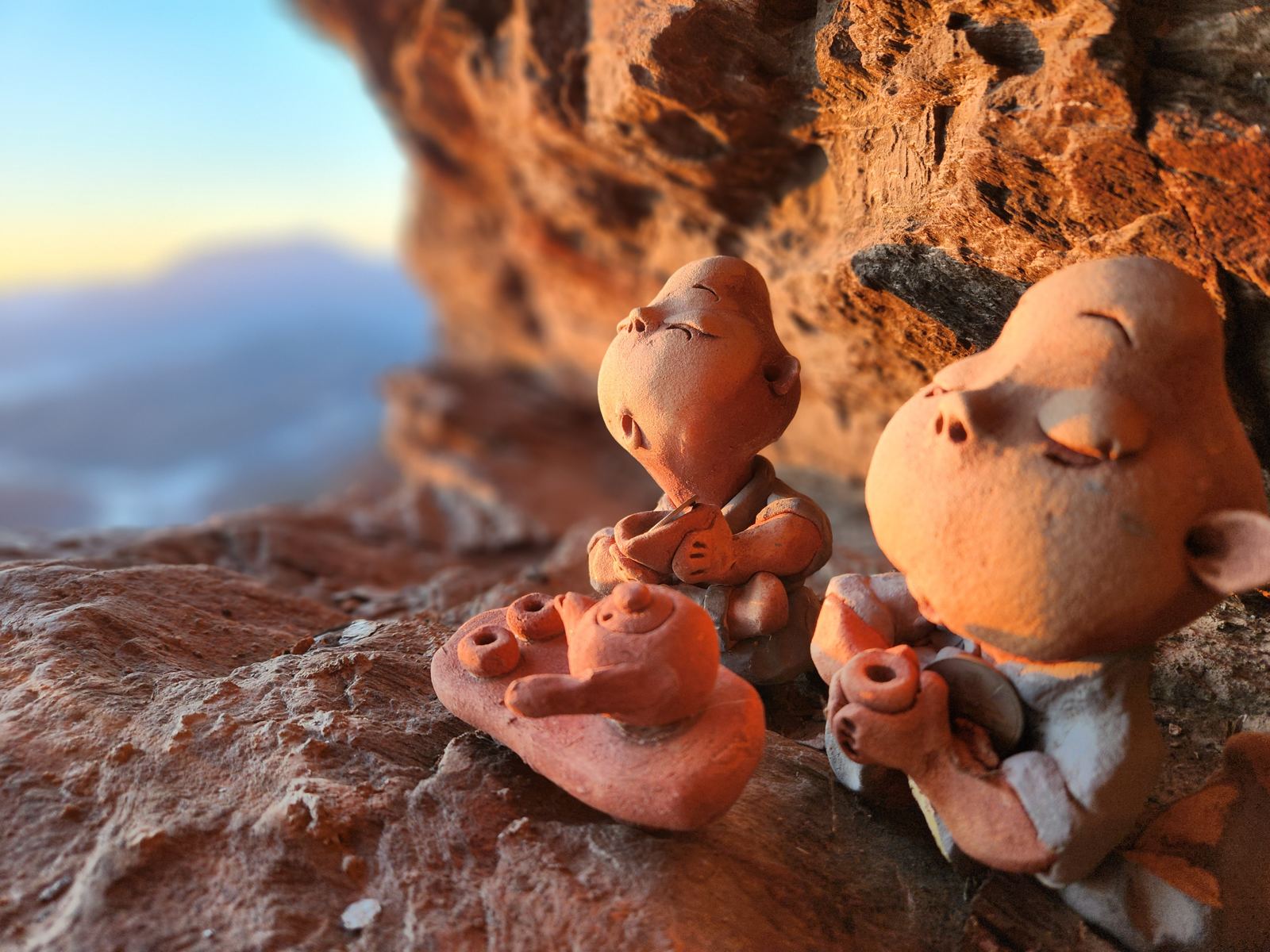
The cliff has other residents. In the cracks and hollows beside the steps, visitors have left little figurines of child monks. One sits in a niche of rock reading a sutra scroll, with a few coins left at his feet. A pair of clay monks share a teapot on a ledge, faces turned up toward the sky as if they had just tasted something very good. Nobody arranged them for show. They have simply collected, one by one, the way small offerings do in places people care about.
A turtle, a peak, and six centuries
Gujeolsa traces its founding to 1393, the second year of the Joseon dynasty, and to the monk Muhak, the adviser to its first king. It was first called Yeonggu-am, the Hermitage of the Spirit Turtle, after a turtle-shaped rock nearby. Later the peak behind it came to be known as Gujeolbong, and the temple took its name from the peak. It fell into ruin in the late Joseon period and was rebuilt by lay followers in 1933, with the main hall raised again around 1950. Nothing here is grand or ancient-looking. What it has instead is its setting.
Up to the summit
Gujeolsa sits below the summit of Sikjangsan, and the top is not far away. From the summit, at 598 meters, you can see the whole of Daejeon spread out below you, and on a clear day Daecheong Lake as well. It is a popular spot for sunrise and for night views of the city. You don't have to hike to get there: a road runs all the way to the summit, with a car park and a small rest area at the top.
Why go
Gujeolsa is not a famous temple, and it does not try to be. But if you want a beautiful mountain road, a quiet temple yard and something you won't see elsewhere, it is worth the early start. Come at sunrise if you can, when the cliff catches fire and the two little shrines glow like lanterns on the rock.
Then climb the steps, take off your shoes, and watch the valley wake up.
Visiting
- Where
- 226 Sangjung-gil, Gunseo-myeon, Okcheon County, North Chungcheong Province. Just east of Daejeon, below Sikjangsan.
- Getting there
- By car is easiest. A winding forest road leads up to the temple, and there is parking.
- Admission
- Free. Open all year.
- Best time
- Sunrise, when the cliff and shrines light up. In May the approach road is lined with acacia blossoms.
- Footing
- The steps to the cliff shrines are steep and narrow. Wear good shoes and take care in frost or rain.
- Etiquette
- The shrines are places of prayer. Take off your shoes, keep your voice low, and leave the figurines and offerings as you find them.
- Sikjangsan summit
- 598 m, open 24 hours, reachable by car. Paid parking at the top (₩3,000 for the first hour at the time of writing). Views over Daejeon and Daecheong Lake.